Saturday, October 15, 2011

Occupy Wall Street

A friend called me this past week to ask if I'd like to go into NYC and give the Occupy Wall Street folks some support. I said, yes! I was delighted to have the opportunity.

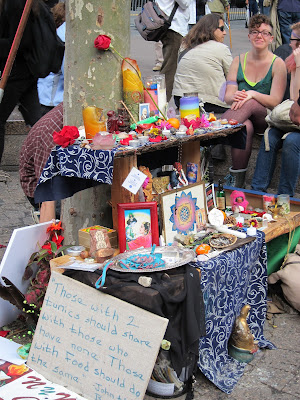
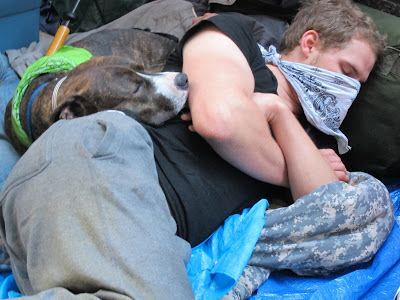
When we got there, I made a point of thanking everyone I met. They were a great crowd of people—all ages, ethnicities and educational levels. Basically, the 99% were there.

The news media—and many people I know—whine that the people involved in this civil disobedience have no polished agenda or demands. Nothing can possibly come of it. 

Relax. Eventually, a unified message will emerge.

The important point now is that people across the U.S. and the world sense that something is terribly wrong and are tired of feeling powerless. They are taking to the streets to gain a sense of empowerment through numbers. Walking among a large crowd of people who are just as frustrated and outraged as you are is validating.

It is obvious that there is a gross inequity of wealth distribution in this country and elsewhere.  We have all witnessed that those in Washington have little intention of doing anything about it. There is a sense that legislation is up for auction, and the highest bidder—corporations and the rich—will always win under our present system. Even the Supreme Court awarded campaign funding and disclosure to the highest bidders by ruling that corporations can be considered persons and are therefore entitled to donate to the candidate of their choice with no limit or identification.

Patience. The Civil Rights movement did not move full tilt the day Rosa Parks decided she was too tired to give up her bus seat to a white passenger. These things build. This is a grassroots movement. Give it time. Give it time.


Wednesday, October 5, 2011

Revisiting the Longest Day

My father was a paratrooper in the 11th Airborne Division in World War II. He told me, when he was still alive, that he was a radio man and among the first to jump into Japan when the Allies liberated the prison camps toward the end of the war. Most of the young men who fought in World War II had never been away from home and now they were scattered across Europe and the Pacific.

My dad, Alfred Friedman, jumping off a troop carrier in the South Pacific.
So it was a sense of awe and gratitude that I recently traveled back in time to the beaches of northern France and the D-Day sites of Pointe du Hoc, Omaha Beach, Utah Beach and Sainte Mere Eglise.

Remembering D-Day

On a rainy day, June 6, 1944, the skies suddenly cleared and the Allied Forces made the decision to go ahead with Operation Overlord, in which Canadian, British and American troops landed on the beaches of Normandy to push the German troops out of France and back into Germany. The D-Day invasion involved 5,000 ships carrying 150,000 men and 30,000 vehicles across the English Channel as well as 800 planes dropping six parachute regiments of over 13,000 paratroopers. An additional 300 planes dropped 13,000 bombs over coastal Normandy in advance of the invasion. Of the Allied troops that landed on the beaches that day, securing French coastal villages, 73,000 of them were Americans.

The men and women of the French Resistance played a very active and invaluable role gathering intelligence prior to D-Day, something that is seldom mentioned. They paid a high price for their bravery. Most were hunted down by the Gestapo, tortured and killed.

Pointe du Hoc: Can you imagine scaling these cliffs?
Our first visit was to Pointe du Hoc, a point of land where American Rangers landed, one hour before the invasion, to scale 100-foot cliffs with grappling hooks.  They did this while under fire from hand-held machine guns the enemy discharged from the safety of concrete bunkers. The Rangers' mission was to disable the coastal gun batteries— huge 155-millimeter guns that could send shells 12 miles out into the ocean or to adjacent beaches. Since the rest of the troops would be coming in by sea, those coastal gun batteries had to be taken out before the invasion force could land. Once the Rangers overpowered the Germans in the concrete gun emplacements, they then had to fight for two days to hold the location, losing more than 60 percent of their men. Afterwards, the remaining 40 percent regrouped and continued Northeast to a rally point one mile from the gun emplacements on Pointe du Hoc.

What the Germans saw from their concrete gun bunkers.
The French—remember this the next time someone says something negative about them—have not touched Pointe du Hoc since 1944. It is considered hallowed ground. So you can still see the concrete bunkers and the craters left by Allied bombers and ships shelling the coastline. Many men were slaughtered trying to make it up those cliffs. Oddly enough, it could have been worse.

Fortunately, Hitler suffered a bad headache the night before, supposedly because he had learned that Rome had fallen to the Allies. So he took a sleeping pill, went to bed and left orders not to disturb him. This was a strategic blow to the Master Race. No one was allowed to make decisions without the Führer’s blessing. The Germans had reinforcements that could have been sent into the invasion area to back up the German troops fighting on the cliffs. But by the time Hitler finished his beauty sleep—he is said to have slept until noon—it was too late. Even when his concerned officers finally informed him of what was going on, Hitler said it didn’t matter. He was more interested in invading London than fighting a defensive war in France. (Bad call.)

"...Comrade in Arms, known but to God."
Our next visit was to Utah and Omaha beaches. The troops were actually supposed to have landed west of there, which would have been strategically better. When they landed at about 6:30 in the morning, the soldiers jumping off the troop carriers encountered mines, barbed wire and heavy gun fire. More than 3,000 Americans died on those beaches from stepping on mines, gunshot wounds and in some cases drowning because they jumped off the troop carriers in water that was too deep, getting weighted down by their equipment. Many more would die in the weeks to come. Men stepped over the bodies of their comrades to run up the beaches and keep the assault going. By mid-afternoon, the Allied troops broke through the German defenses. By August 1944, all of Northern France was under Allied control.

Our next visit was to the American cemetery, a site overlooking Omaha beach. It is difficult to describe the emotions that wash over you as you gaze over the 9,387 gravestones perfectly aligned in row after row to the horizon. Most have names, but several hundred do not (see photo above) because some soldiers were never identified. Those buried came from every state in the union and represent just about every ethnic group you can imagine. What is striking is that most of the fallen range in age from teenagers to early twenties. They made the ultimate sacrifice and never had the opportunity to have a career or family like the rest of us. Just writing about it brings tears.

Finally, we visited the small town of Sainte Mere Eglise, where soldiers parachuted down into the French countryside in the dark in advance of the beach invasion. This was supposed to have been a surprise landing under cover of darkness. Unfortunately, a house caught on fire and a bucket brigade of villagers was working to extinguish it. The occupying Germans came out to survey what was going on. The night, lit with the rising flames, revealed a sky filled with descending parachutes. The Germans ordered the citizens back into their homes and began firing on the troops while they were in mid-air. Many were dead before they hit the ground.

Steele hung from this church steeple.
The parachute of one soldier, John Steele, caught on the town’s church steeple and he hung there, playing dead, in hopes of not being killed. The Germans eventually took him prisoner. Steele later escaped from the Germans and rejoined his division when U.S. troops attacked the village, capturing thirty Germans and killing another eleven.

The success of D-Day changed the course of history. Hitler was forced to fight a two-front war against the Russians in the east and the Americans, British, Canadians and French in the west. Within a year, Hitler committed suicide, and the war was over.

Reflections on War

Some wars are unavoidable, even noble; others are not.

It is appropriate to honor those who serve and protect our country. But prudent to be wary of the well-heeled, duplicitous legislators and contractors—many of whom have never served—who carelessly send today's soldiers into harm's way for hidden agendas.

We owe that important distinction to our troops and to our country.

Tuesday, September 27, 2011

Dreggs Across the Atlantic

When my children were small, I used to get them to finish their meals by threatening to sing. It worked. My family, quite simply, has never been able to stomach my crooning. So when Steve and I recently took a transatlantic cruise on the Queen Mary 2, I decided—perhaps in an act of defiance—to take the songwriting course offered by award-winning musician/lyricist Chris Difford of Squeeze fame.

Clare, the most animated woman I've ever met.
Before the cruise, I wrote lyrics for about five songs. While I am not musical, I am a professional writer, so was hoping I could contribute lyrics to the songwriting effort. The first day of class a large crowd of people showed up in the ship's ballroom. There were several mentors, so we were divided up into small “bands.” My band, which came to be called Bitter Dreggs, consisted of Pam from Australia, Renee from England and Richard from New York. Our mentors were a husband/wife team, Clare and Matt Deighton from Wales. Fortunately for my ego, all of my band mates were unqualified amateurs like me. Richard, a former corporate lawyer, played guitar. Pam, who had studied ethnic music, played keyboards. Retired school teacher, Renee, and I—for the love of God—sang.

Our mentors were professional musicians. Clare had been trained in opera but had somehow strayed off to become a rock/folk vocalist. A petite blond, she had a tremendously deep and powerful voice. Her energy level rivaled the internal combustion of the sun. She could always be counted on for a supportive wink, a naughty smile and a conspiratorial hug. Her husband, Matt, has played guitar in many bands including Oasis (standing in for Noel Gallagher) and composes music. He was the God of Calm, gently smiling, his face framed with curly black hair streaked with gray. Now and then he flashed an impish smile as if just he and you were sharing a private joke.

Matt, having a philosophical moment with his guitar.
On our first day, we introduced ourselves, then got down to brainstorming lyrics for the song, There Goes the Serenity of the Day. I had suggested the title in honor of Albert Camus and his book, The Stranger, which affirmed my nerdiness. (See lyrics below.) It was an existentialist blues song about a drunken reprobate and the woman who gleefully left him. Other groups had chosen more uplifting and less literary subjects, many of which seemed like shameless attempts to sell the QM2 corporate advertising department a new theme song. (Not a bad idea.) My favorite was a song about Dubai. You had to be there to appreciate the humor.

After we came up with lyrics, Matt composed the accompanying music and we began practicing between bridge matches and other activities. Our mentors were lenient as they were acutely aware that, as vacationers, we had the focus of truant teenagers with attention deficit disorder. After two days of sporadic practice, we gathered in a small room in the underbelly of the ship for a recording session. We sang and played like a gang of unruly sots, then a guitar solo and harmony were overdubbed on the track. Our band was told that the results, following some tidying up, would be emailed to us after the cruise.

Next, we practiced primitive choreography for the benefit of whichever misguided passengers might wander in to our recital in the main Royal Court Theatre. This consisted of swaying in time with each other, throwing down hats on the correct verse and pointing accusingly at Richard, who good-naturedly played the part of the reprobate in the song.

Bitter Dreggs, oy! (l to r): Richard, me, Clare, Pam and Renee.
Finally, showtime came and we were paraded into a special section of the theatre to sit and await our turns on stage. It reminded me of grade school, when students sat in the auditorium by class and took turns filing up to the stage to participate in a Christmas pageant.

I asked Clare if we could have a few guitars to smash at the end of our bit.  After all, I reasoned, shouldn't a part of the rock experience include indulging in demanding and deviant behavior? She wandered off cheerfully mumbling about Cunard adding it to our bills.

Our band was told we would go on first, which suited us fine. In fact, we ended up being second to last, which also suited us fine. When our turn finally came, we trundled up the steps to the stage, received a brief and encouraging introduction from Mr. Difford, then got on with it. I noticed my husband was about fourth row center in the audience with his camera going. This was about as close a brush with showbiz that we would ever have, so might as well milk it for all it was worth.

The Bitter Dreggs wailed its tune of woe to the audience, who was appreciative in the same way Mom had been during the Christmas pageant. Fortunately, my microphone was not working, so I was free to belt out the lyrics with impunity. I had such a good time that I forgot to throw down my hat at the appointed moment, but no one noticed.

Chris Difford puts the move on me--hey, hey, and that's okay.
My mentors surprised me by taking the time to read my pre-written song lyrics. They showed them to Chris Difford, who offered encouragement, and to another mentor, singer/songwriter Geoff Martyn, from Scotland. Geoff composed music for one song, about my father, and recorded it for me. Matt and Clare said they intended to record one of my other songs, Invisible, when they got back to their farm/studio in Wales.

Overall, the songwriting course was the unexpected highlight of the cruise for many passengers. We made friends with people from all over the globe, shared more than a few good laughs and wallowed in some delusional fun for a week.

On a personal level, perhaps most satisfying was the opportunity to sing publicly sans the usual familial scorn—and without the artistic pressure of trying to persuade my now-grown children to finish their vegetables.

There Goes the Serenity of the Day
By the Bitter Dreggs

I wake up in the morning with a beer can in my hand;
The sun is cruelly searing on my eyeballs like a brand.
My bed turns out again to be the bonnet of a car.
My woman and my job gone, I’m not going very far.
My brew is getting flatter, I’m looking for a high.
She left me for a lawyer with a collar and a tie.
Now I’m sliding in the gutter and falling out of sight
My life is getting darker but I always liked the night.

There goes the serenity of the day, hey, hey, hey, hey, hey, hey.

I always knew my woman wouldn’t stay 'round very long
She ran off with my lawyer and they both did me wrong
He dropped my case, she left me, they even took the dog
I’ve lost my brilliant future in a drunken, beer-hazed fog.

There goes the serenity of the day, hey, hey, hey, hey, hey, hey.

And she said:

It’s true I found a lawyer in a collar and a tie
I’d left him for his drinking, his cheating and his lies
I’m living in suburbia; he’s living in denial
Now they’ve reclaimed his auto and I’ve reclaimed my smile

I’ve got the serenity of the day, hey, hey, hey, hey, hey, hey.
I’ve got the serenity of the day…and I’m okayyyyyyy!


Monday, September 5, 2011

Let Them Eat Cake

We recently went to a wedding in New York City. On a hot, early September day, more than 50 people crowded into a humid apartment in lower Manhattan to witness the vows of two people who define what relationships should be. (Unlike the pampered suburbs, many apartments in the city do not have air conditioning. So only the strong survive.)

The wedding favor: a long-stemmed glass and Sanskit passage.
"Love is no assignment for cowards."—Ovid

Since they work in show business, the ceremony included actors reciting poems and passages, a composer performing songs he wrote just for them and the couple, themselves, singing a duet. So this wasn’t just a wedding, it was a free and wildly entertaining show.

Steve and I are admittedly sentimental. Whenever we go to weddings, we find ourselves holding hands, smiling at each other and fighting back the tears. Weddings showcase love and its ideals at their romantic best. Forget the fact that one out of two marriages fail. This one won’t. Sometimes you just know that, and that’s what made this day so inspiring.

"My heart is ever at your service."—William Shakespeare

People flew in from all over the country for the affair—from Los Angeles, the Carolinas and other far-flung places. We happily took an hour’s train ride in from Jersey and braved the irregular holiday subway schedules to find our way to this special moment in time. The apartment was filled with stylishly dressed and very charming guests, all bubbling with joy.

Top, coconut; middle orange; bottom, lemon.
In a departure from the usual nuptial fare, all the hors d'oeuvres and a beautiful two-tiered wedding cake (see picture) were prepared by the groom, Eric—an incredibly talented and artistic man.

But what made this gathering so truly remarkable was the fact that it happened at all. These endearing people—one from South Carolina, the other from Rhode Island—first made eye contact with each other across a crowded bar in New York City, and it was love at first sight. There's a 20-year difference in their ages, but that proved no obstacle. They have lived together for 15 years and have wanted to affirm that love through marriage. The final barrier to that goal fell away this past June, when New York Governor Andrew Cuomo raised a pen to sign ground-breaking, same-sex marriage legislation into law. It went into effect 30 days later, meaning that same-sex couples could begin marrying in New York by late July. In August, our friends decided to get married and three weeks later, marriage certificate in hand, they tied the knot.

"Was it love at first sight? It wasn't then—but it sure is now."—Ann Meara, of her 30-plus-year marriage

So it is with a sense of exquisite delight that I wish Russ and Eric all the happiness and rich complexities that marriage may bring—and many joyful anniversaries to come as spiritually and legally blessed soul-mates. 

Friday, September 2, 2011

The Brighter Side of Darkness

A downed trellis was our only casualty.
"Darkness is to space what silence is to sound—the interval."—Marshall McLuhan

Recently, New Jersey was assaulted by the howling winds and torrential rains of Hurricane Irene. It traveled up the Garden State Parkway, jumping tolls along the way. A week later, many areas of the state are still flooded. Most of the wonderful mom-and-pop stores in nearby Denville ended up in the middle of a raging river and are now out of business—permanently altering the psyche of the town.

Steve and I were lucky that the worst thing that happened to us was that our metal trellis was ripped out of its concrete foundation and thrown down on its side—and we lost our electricity for a day.

Those of us in developed countries rarely have an interruption in our energy supply, so when it happens, it can be a startling reminder of just how dependent we are on things beyond our control. Electricity is necessary for our grooming (hot water), sustenance (refrigerator, stove) and entertainment (television, computer games, Internet).

"I will love the light for it shows me the way, yet I will endure the darkness because it shows me the stars."—Og Mandino

When the lights went out, we donned flashlights, lit candles, and then realized that we had no idea what to do with ourselves. Our activities were reduced to reading books by battery-powered booklights or brushing up on conversation. Undoubtedly, there will be a crop of "hurricane babies" next June. At first, the blackout seemed terribly inconvenient and boring. Eventually, I found it relaxing (less mental clutter) and reminiscent of when I was young and there was no cable, computers or Internet.

As children, we sought entertainment by running out into the neighborhood and playing with whomever was around that day. The rule was we had to be home by dark. Our parents chatted with neighbors as they did yard work. Everyone on the block knew everyone else. There was a sense of community and connection.

Denville: Flood insurance doesn't cover hurricane damage. [NJ.Com]
I remember having a very relaxing childhood. I went to school, played with friends, ate dinner with my family, did an hour of homework (only after fourth grade), watched television if there was anything interesting on the seven television stations our antenna received (Channels, 2,4,5,7,9,11 and 13) and went to bed. I also read a lot of books, drew pictures and listened to music on the radio. The technology in our home consisted of one black-and-white television, a radio and a rotary telephone in the livingroom—all conversations were public.

"Light thinks it travels faster than anything but it is wrong. No matter how fast light travels, it finds the darkness has always got there first, and is waiting for it."—Terry Pratchett

We were the Baby Boomers—the children of returning World War II soldiers. That upwardly mobile generation that protested against wars and social injustice instead of spending hours playing World of Warcraft or chatting on Facebook.

It's a Tilt-a-Whirl World.
My children do not seem very relaxed. They are in their twenties and always seem stressed out and exhausted. The economy is in a slump and the world is pretty grim—financially, politically and environmentally. We live in a blaring, fast-paced, electronic Tilt-a-Whirl. Perhaps it is a back-handed gift to have our power suddenly turned off, our incessant electronics silenced. Just for a short while, if we are prepared to accept it, the experience presents us with a soothing swathe of darkness.