Showing posts with label architecture. Show all posts

Wednesday, April 6, 2011

Fuels Rush In...


“I have learned through bitter experience the one supreme lesson to conserve my anger, and as heat conserved is transmitted into energy, even so our anger controlled can be transmitted into a power that can move the world.”
—Mahatma Gandhi

I don’t mean to be a spoil sport, but all the articles I have read about reducing energy consumption are crap. Why? Listen to the news. All you hear from politicians and insipid "news" programs is the same recycled suggestions about shifting from one type of energy generation—say coal and oil—to another type of energy generation, say nuclear, solar, wind, etc. I have not seen a strong drive to do something equally or perhaps MORE important—to begin building a humbler lifestyle that is more sustainable. Oddly enough, the ability to do this already exists.

Let’s talk homes. When articles expound on energy-efficient homes, they talk about such band-aids as double-paned windows, improved insulation and fluorescent light bulbs. Lame. If we really want to make a dent in energy consumption, it has to begin with our concept of what a home is in the first place. It’s time to walk away from environmentally defiant homes to something more meaningful. I’m talking truly sustainable homes, from the ground up. Homes that completely reject the current notions about what a home looks like, how much space we really need to live and how a house functions. There are numerous examples out there, but for the purpose of this piece, I'll showcase two.
The self-operating, completely solar, zero-energy LUMENHAUS.

Let’s start with the LUMENHAUS™. This amazing example of solar housing was designed and built at Virginia Tech. Its innovative design combines architecture with technology and won the international Solar Decathlon Competition in Madrid, Spain in June of 2010.

LUMENHAUS has open, flowing spaces. The north and south walls are all glass, maximizing the exposure to daylight. Its design uses technology to make the owner’s life simpler, more energy efficient and less expensive.

LUMENHAUS is a zero-energy home completely powered by the sun. Its sustainable architecture features compact volume, little air infiltration, strategic insulation, natural/cross ventilation, passive heating, and integrated geothermal energy sink. (Geothermal energy is derived from wells drilled deep into the surface of the ground to tap into the Earth's natural heat.) Design and material selection aim to reduce indoor pollutants, minimize global warming, reduce waste, include recycled content, represent low energy in manufacture and harvest, limit destruction to habitat, and rapidly renew resources. Sign me up!
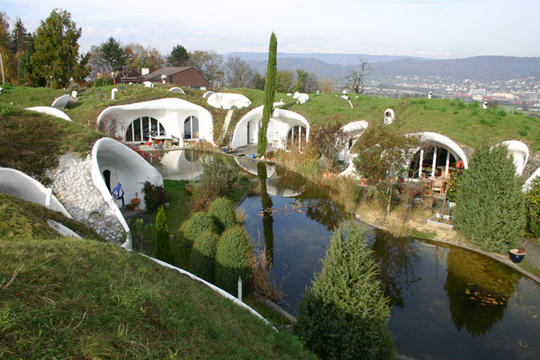
Homes built into hillsides, courtesy of the Swiss.
Now let’s move to Switzerland. Here, they are building Hobbit-like homes into hillsides. Inhabitants of these earth homes in Dietikon, Switzerland, are said to live not under the earth but with the earth. The homes are constructed from various natural and recycled building materials and then blanketed by grass for protection from rain, low temperatures, wind and abrasion. Homes are clustered around a lake and situated towards the south to maximize exposure to daylight. Natural light is brought in via skylights whenever possible. The compound, which includes an underground parking lot, was built using recycled glass and sprayed concrete, and then topped with a protective, natural green roof. Nice.

This low-impact woodland home was built by a gentleman in Wales.
"If sunbeams were weapons of war, we would have had solar energy centuries ago."—Sir George Porter

If we're really serious about sustainability, forget the pointless squabbling over drilling versus mining versus construction of nuclear plants. It's time to replace the desperate search for more energy with a feverish sense of immediacy over reducing or eliminating what is gluttonously feeding that need. Let's completely re-tool the way we approach our homes, appliances, vehicles and overall consumption habits.

Beddington Zero Energy Development housing units near London.
Granted, there is little financial incentive with status quo energy producers, builders and manufacturers to move in this direction. The demand for sustainable homes and lives would have to be a grassroots movement with some visionary entrepreneurial companies leading the way. And those corporate standard-bearers would have to demonstrate a commitment to making what they build affordable for the average person. Ideally, the government—and I'm not holding my breath—would offer grants to knock down existing nonhistoric, energy-gobbling homes to be replaced by these zero-energy babies.

Yes, re-tooling factories and thought processes is financially and emotionally painful. Still, until there are substantial changes in the way we live, not just in how we scramble to amass greater volumes of energy generation with the aid of our military, it is difficult to believe that we are in any way serious about living sustainable lives. Nor is it possible to feel any sense of optimism for the future of humanity or the planet we so ineptly inhabit.

Wednesday, October 20, 2010

The Importance of Posturing

These visionary apartment buildings overlooking the Tromsø strait were designed by 70°N Arkitektur of Norway http://www.70n.no/.

When I was in my 20s, I went to a doctor who informed me, as if proclaiming from a tablet brought down from Mount Sinai, that if I didn’t improve my posture, I would definitely be in a wheelchair by the time I was 50. He strongly suggested that I take up tennis. But tennis is for sissies so I never did that, and I have lived long enough to prove him wrong. My posture still remains strikingly slumped, as I have spent my life hunching over a keyboard, but I remain a functioning biped.

Many people have pointed out to me over the years that good posture is essential to beauty, social life or health. I have heard this from my chiropractor, general practitioner, yoga teacher, homeopath, personal trainer and landscaper—with the latter garnering the most credibility to my mind. Still, while I can straighten up if I’m thinking about it, I get preoccupied with life and soon find gravity pulling me back into the same Neanderthal pose I have always held.

It is worth mentioning that I do not have any serious back problems, or any significant health problems at all for that matter, so I am not sure why people get so disturbed about the acute angle at which I hold my spine.

I’m sure there have been many great people throughout history who have been perfectly successful, temporarily at least, with a less than ramrod silhouette. They might include King Richard III of England (aka the Spider King); Helen Thomas, a renowned Washington reporter; and Igor (of Frankenstein fame) who held a respectable lab position.

Even architecture has paid homage to the merits of a less than perpendicular approach. The Leaning Tower of Pisa is a timeless reminder, and more recently, there are flashes of structural brilliance such as the leaning buildings of Tromsø strait in Norway (see photo above). Now that’s where I want to live!

Indeed, Nature is filled with slumping examples of powerful creatures like panthers, hyenas and elephants. None of them seem to be uptight about how they hold themselves. You don’t see anyone walking behind a leopard lecturing it about the merits of a head held high (not for long, anyway).

I think it’s time to dispel the unfounded superstitions about how life will go terribly wrong if one’s head is not squarely situated over one’s tailbone. It is time for us all to proudly exhale, curl our shoulders inward and lean forward into the future.